Balance · 12 minute read
What balance actually is, and why it wobbles
Three separate systems arguing about where you are in space. What a wobble is, what you are really practising when you practise a balance, and why the second side is always worse.
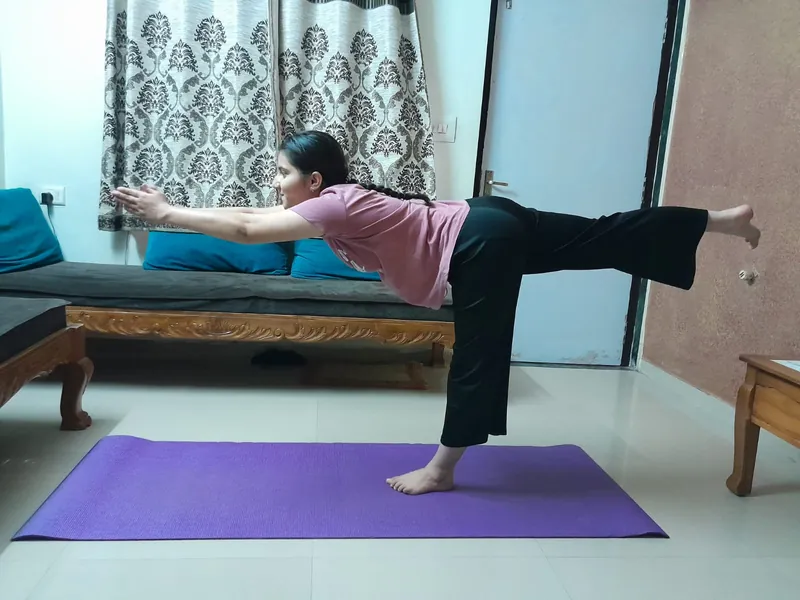
Standing on one leg feels like one skill. It is not. It is three separate information systems reporting to the same place, and almost everything interesting about balance comes from what happens when they disagree.
The three reporters
Your eyes
Vision is the loudest of the three and the one most people lean on hardest without realising. Your eyes tell you where vertical is by finding edges in the room — door frames, the line where the wall meets the ceiling, the horizon.
You can prove how much of the work your eyes are doing in about four seconds. Stand on one leg next to a wall. Once you are steady, close your eyes. Almost everybody becomes dramatically less stable immediately, and the difference is the size of the contribution vision was making.
This is also why balancing is harder facing a blank wall than facing a room, and why a busy video call in the background makes it harder still: moving edges give your eyes conflicting reports about which way is up. In class we say "find a point that is not moving and leave your eyes on it", and that is the entire reason.
Your inner ear
Inside each ear, behind the part that hears, are three fluid-filled loops set at roughly right angles to one another, plus two small sacs. The loops detect rotation — your head tipping, turning, nodding. The sacs detect straight-line acceleration and which way gravity is pulling.
This is why turning your head while balancing is so disruptive. You have not changed anything about your feet, but you have just set fluid moving in three loops and the system needs a moment to work out whether that motion means the head turned or the world did.
Looking up at a lifted hand is the same problem, which is why every pose guide on this site says looking forward is a complete version.
The sense of where your own parts are
The third one has a name most people have never heard: proprioception. Sensors embedded in your muscles, tendons and joint capsules report continuously on length, tension and angle, and your brain assembles that into a running map of where your limbs are without having to look.
It is the reason you can touch your nose with your eyes shut, and it is the system that standing practice uses most. In a balance, the sensors in the sole of the standing foot and around the ankle are producing a constant stream of corrections — weight moving a few millimetres forward, the ankle responding, weight coming back.
So what is a wobble?
Here is the part worth taking away: a wobble is not a failure of balance. A wobble is balance happening.
You are never actually still. Standing on two feet, perfectly relaxed, your body sways continuously in small amounts — a few millimetres, constantly, in every direction. The ankles make tiny corrections dozens of times a minute and you are completely unaware of any of it. Standing on one foot does not introduce the sway. It removes the second foot that was quietly absorbing it, so the same sway that was always there becomes large enough to notice.
This reframes what you are doing when you practise. You are not practising being still, because being still is not available. You are practising correcting — noticing a drift early and responding to it small, rather than noticing it late and responding to it big.
And it explains the thing everybody describes: that the first fifteen seconds of a balance are easy and then it falls apart. In the first few seconds you have not drifted far enough to need much correcting. By twenty seconds you have, and the corrections start arriving. If they arrive late they are large, a large correction overshoots, and the overshoot needs correcting in turn. That is the wobble-and-recover cycle, and getting better at balancing largely means catching the drift earlier so the corrections stay small.
Why the second side is worse
Almost everyone finds the second side of a balance harder, and it is worth saying plainly that this is normal and not worth being annoyed about.
Some of it is genuine asymmetry — most people stand with more weight on one leg habitually, carry bags on one shoulder, lead with one foot going upstairs. Some of it is simply that by the time you get to the second side you have already spent thirty seconds working. And some of it, honestly, is that you now know what the pose feels like and have started having opinions about how it is going, which is its own distraction.
What we do in class is hold the first side slightly shorter than you could, so the second side is not being compared against your best effort.
Not medical advice
This describes how a movement works, which is what a yoga teacher can usefully tell you. It is not medical advice and it is not about any condition. If balance, dizziness or falling is a concern for you, that belongs with a doctor who can look at the actual cause — there are many, several are treatable, and none of them is diagnosable from a web page.
The things that actually make it easier
In rough order of how much difference they make, and none of them is "try harder".
- Look at something that is not moving. A fixed point at eye level, two or three yards away. Not the floor — looking down tips the head forward and sets the inner ear going.
- Spread your toes and press them down. You are widening the base. A foot with the toes gripped up is balancing on a smaller area than it has available.
- Soften the standing knee. A locked knee cannot make small corrections; it can only wait until the correction has to be a large one. A micro-bend keeps the ankle and knee available.
- Breathe out slowly. Most people hold their breath in a balance without noticing, which stiffens everything that needs to be making small adjustments.
- Use a fingertip on a wall. One finger, lightly. The amount of mechanical support a single fingertip provides is almost nothing, and the amount of information it provides is enormous — your brain gets a fixed reference against which to measure the drift. This is why fingertip support is a genuinely different thing from holding on.
- Pick a harder arm position last. Arms overhead raises your centre of mass and narrows your margin. Hands at the chest is not a lesser version, it is the version with one fewer variable.
What practice is actually practising
Not strength, mostly. A one-legged stand asks very little of the muscles; what it asks a lot of is the loop between sensing and responding.
So the useful kind of practice is frequent and short rather than long and occasional. Thirty seconds on each leg while the kettle boils, most days, puts you through the sense-and-correct loop far more times than one long session a week does. Nobody needs a mat, a class or a change of clothes for that, which is why we keep suggesting it.
And there is a ceiling worth knowing about: balance is quite context-specific. Getting good at Tree on your bedroom carpet makes you good at Tree on your bedroom carpet. The transfer to other surfaces, other footwear and other distractions is real but partial, which is an argument for practising in slightly different places rather than perfecting one.
Where this stops
Everything above is a description of a mechanism. It is not a claim about what practising will do for you, and you will notice this piece has not made one.
That is deliberate. There is a great deal of confident writing online about balance practice and its effects, and almost all of it is further ahead of the evidence than its tone suggests. We teach movement. What happens in a particular body over a particular year involves age, medication, vision, inner-ear health, neurological conditions, joint history and a dozen other things nobody can see from here.
If balance is something you are worried about rather than just interested in — if you have fallen, or felt unsteady in a way that seemed new, or been told it is worth watching — please take that to a doctor rather than to a yoga class. Several of the common causes are straightforwardly treatable and none of them is improved by being left alone. A class is a fine thing to do as well. It is a bad thing to do instead.
Where to go next
The Tree guide and the Warrior III guide are the two balances on this site, both with chair and wall versions in the same box. The standing foot covers the third system in far more detail, since the sole of the foot is where most of the useful information comes from.